Following being an intern for the Quaker Aging Resources Support Group, Joey Szpilczak was invited by Sheila Sorkin, PYM Aging Support Coordinator to meet with friends who were open to discussing their artistic journey and connection to spirituality and aging. Joey shared her excitement to speak with friends and hear their perspectives! Several friends are members of Home – Fellowship of Quakers in the Arts (FQA) which began by members of PYM. Included in this article, Jesse White is both a member of FQA and a former Clerk of the FQA Board. Joey developed the following questions when interviewing friends. Jesse’s responded directly to those questions. Below you will see their stories and art.
1.What is your artistic practice or passion, and what draws you to it?
I am a Narrative Expressionist visual artist and writer. It is important to me that my work tells a story that makes the viewer/reader feel. Stories are powerful medicine and gifting an emotion is how we find empathy and connection. My favorite mediums to work in are oil painting, altered book arts, and poetry. I also love tapestry and circular weaving, and playing the piano. My life callings are to create, to teach, and to heal.
2. How did you come to both Quakerism and your creative practice?
When I was four, I started attending Frankford Friends School. My emotions were too big for me—I was easily overwhelmed, always anxious, and usually panicked. I cried every day, not because I hated school but because I couldn’t find peace in all my big feelings… until we practiced silence. Silence took the edge off. I was still nervous that I would accidentally make noise and disrupt the peace, but with enough time I rested in it, and it rested in me. I told my mom there was school on Sundays. She corrected me but I insisted, “there is First Day School and we are going.” We never signed the guest book at Frankford Friends Meeting. We were already home.
First Day School was an opportunity to connect that peace I felt in silence with creativity. There were artists as First Day School teachers and learning art techniques was also a way to experience the magic (mysticism) of God. I was five when I first heard the voice of God through messages in community worship at PYM annual sessions. Someone shared song lyrics that were meaningful to her and later, out of the silence, someone else was moved to sing the song. I cried, but this time for the beauty of God’s voice.
3.How does your Quaker faith and your creative practice inform each other?
My faith and creativity have always been united. As a mystic, I find a liminal space within me between what is human and what is divine. I find that simple prose cannot fully capture the beauty and grace of God. Poetry casts a web that can capture the meaning of the Divine’s messages and visual art shares God’s messages through me to you without the small containers of words. At Guilford College, where I was first pursuing education towards becoming an expressive arts therapist, I was called to include my faith into my learning. I was able to do this through the Quaker Leadership Scholars Program and through pursuing an Integrative Studies degree in “Creative and Spiritual Process” in addition to my Psychology degree. My ministry has connected Arts and Spirituality with teaching and healing since that time. I worked at Pendle Hill as the Arts and Spirituality Coordinator for many years. Presently, I serve as the Director and Transitional Life Coach (through creativity and interfaith spirituality) for Pigeon Arts (pigeonarts.org).
4. Has the relationship between your art and your faith shifted throughout your life? How have these practices changed your understanding of yourself and of community?
My creative expression has always an essential part of being in relationship with Spirit. As young children each of us was a creative genius. We are conditioned out of understanding ourselves as creative through educational grading systems and social pressures. I deeply want Friends to witness their own creativity (if not in the arts, then in cooking, gardening, problem-solving, creating safe spaces, waiting together for new ideas to emerge out of waiting worship…). Creativity is a path to discernment, to following a leading, to living into the Beloved Community we want to see.
Additionally, I believe that there are as many paths to and with God as there are beings. I strongly believe that each of us can hear Spirit’s leadings and callings if we practice deep listening and discernment. My Quaker faith is augmented by my creativity, and Universal Shamanism and Tarot practices. I’ve known Jewish Quakers, Buddhist Quakers, and Muslim Quakers who maintain deeply personal and transformative relationships with God. It is important that we use the spiritual language that resonates most deeply with our own experiences, and to truly hear the spiritual messages in the words of others (instead of getting stuck on spiritual language that is not our own.) This is a path to peace.
5. Is there a piece you made that you feel most directly emerged from your spiritual life?
I’ve been journaling through poetry since I was seven years old as a direct conversation with myself and with God. My visual art is almost always an extension of Spirit’s work through me. I am happy to share an image of my large painting entitled “streetlampdancer” that moved through me. In the image a young girl dances at night in the rain beneath the light of a street lamp. All around her the world carries on—the rain, the chain link fence, the bird on the wire, her lost shoe, the barking dog, the neighbor shouting to get her tush back home—yet she is in bliss, mesmerized by her dance and the Light.
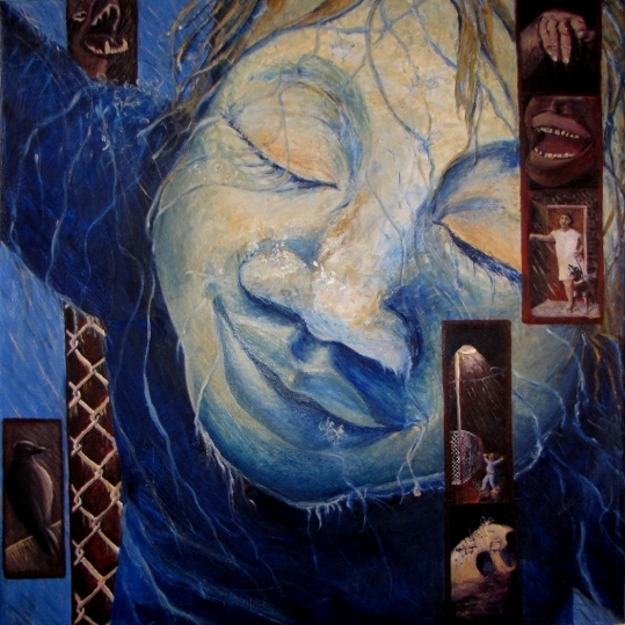
Jessie White, Alternate Clerk of former Frankford Friends Meeting Monthly Meeting, currently Frankford Executive Meeting
Director and Spiritual Arts Doula, Pigeon Arts pigeonarts.org