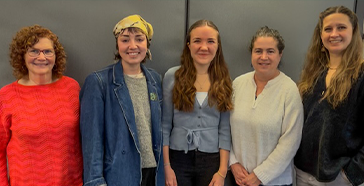
Joey Szpilczak served on the Quaker Aging Resources Support Group which provided insight to the FFA funded project to Reimagine Quaker Aging Resources. The group helped her celebrate her 17th birthday!
My name is Joey Szpilczak, and I am a current junior at Germantown Friends School in Philadelphia, Pennsylvania. My junior project began with a hope to give back to my community by working with different organizations and individuals, including the Philadelphia Yearly Meeting and an art therapist in UPenn’s Radiation Oncology Department, as well as through an independent project creating creative kits for a rehabilitation hospital and memory center. For context, at my school, the junior project program is an opportunity for students to take the month of January away from regular classes to field explore and contribute meaningfully outside of the school setting. In thinking about how I wanted to engage with my surroundings, I kept returning to the Quaker Meeting. When I entered Germantown Friends in ninth grade, I was introduced to Quakerism for the first time. I was struck by its emphasis on contemplation and nonviolence, as well as the importance placed on active listening. In this space, I found not only a philosophy I aligned with but also a community that truly welcomed me. This project was my way of contributing to that space while collaborating with others to form intergenerational and creative opportunities.
Before this experience, I was already drawn to work centered on storytelling and community building, particularly through my involvement in artistic settings and working with organizations such as Mural Arts. I have always believed in the power of art as a contemplative and connective practice and wanted to explore ways of integrating it both into community and individual empowerment. At the same time, my own family history of immigration from Ukraine to the United States and hearing their harrowing experiences of searching for refuge has shaped my understanding of the importance of intergenerational relationships. These stories reinforced for me the importance of learning across generations as a way to sustain memory and preserve history. These influences led me to focus my project on aging support and intergenerational connection within the Quaker community.
Through my internship with the Philadelphia Yearly Meeting, I have had the opportunity to interview Friends of various ages, both virtually and in-person, for the Quaker Aging Resources (QAR) pamphlets, with a focus on Generational Relationships and Celebrating Aging in Your Faith Community | Quaker Aging Resources celebrating aging within the faith community. Through these conversations, I discovered how powerful it is to listen and appreciate the small interactions. Each story, whether about someone’s broader spiritual journey or their particular experiences with individuals within their meeting, left a lasting impact on me. I began to see how these individual narratives weave together to form a powerful, collective story. Those singular conversations became some of the most meaningful parts of my project.
In addition to conducting interviews, I helped to organize an intergenerational gathering centered around a collaborative quilt mural project. Participants, both young and older Friends, worked side by side to express their messages through art. One of the key objectives of this project was for participants to reflect on how their individual narratives fit into their larger community and how each individual’s story brings necessary life and perspective to the Meeting. This process became more than just creating something visual, but rather a way of building connections and learning from each other. I witnessed how art can serve as a bridge across generations and allow people to communicate in ways that center both individual agency and community power.
Going into this experience, I felt both excited and at times uncertain. I do not know exactly how people would respond or what would come from these interactions. What I learned, however, is the importance of reaching out. This project would not have been possible without the support and openness of others. Sheila Sorkin, PYM Aging Support Coordinator, provided the opportunity to begin this work and truly supported me throughout this process. Kristin Simmons, the Youth Engagement Coordinator, as well as the Young Friends who participated, brought energy and willingness to engage, helping this project come to fruition. Germantown Monthly Meeting, the meeting that first introduced me to Quakerism through sitting in their meeting house each week, welcomed us and provided a space for deep connection. I am also grateful to the teachers at my school who helped me shape what this project could be and supported me through the process. Each of these individuals played a role in making this experience possible, confirming how impactful human interaction is.
This project deepened my belief in the importance of intergenerational relationships and the strength of community. It showed me that connection often begins with something simple, such as a conversation, even an email, and the willingness to listen and share space with others. I leave this experience with a profound appreciation for the stories that shape all of us and a desire to continue this work in building spaces where people of all ages can come together and create something meaningful.
About our video….
Chris Stern grew up in Rockland Friends Meeting in New York. He moved to Philadelphia to study music and ended up staying here to study Early Quaker writings at Pendle Hill. He is a retired Special Education teacher, recorded Quaker minister, member of Middletown Meeting, and the part time coordinator for Concord Quarterly Meeting. His recently published Quaker biography, “Who Turned on the Light?” is available on Amazon.
Rich Ailes is a long-time member and current clerk of Middletown Monthly Meeting in Lima PA. He is the recording clerk of Concord Quarter and manages the Quarter’s website and newsletter. He has participated in the Quarter’s Working Group on Aging Concerns since 2017. He enjoys photographing birds, gardening, and playing guitar.